

Since the formation of the National Highway Traffic Safety Administration in 1970, vehicle safety regulations have continued to evolve, impacting every aspect of automotive design, including glass. The OptiGauge® II helps with the process by obtaining highly accurate, non-destructive glass thickness measurements to ensure compliance with manufacturer specifications.
When Technology Meets Driver Safety: HUD Windshields
For decades, windshields have been composed of two pieces of glass, each approximately 2mm thick, with an approximately 1mm layer of vinyl sandwiched between them. Today, many windshields have incorporated an additional thin, sound-absorbing vinyl layer designed to reduce road noise.
Now, optimized technology and driver safety are key factors in windshields. Heads Up Display (HUD) windshields provide drivers with access to important dashboard information, such as speed and navigation, while also offering the safety benefit of keeping eyes on the road and reducing driver distractions. By keeping drivers' eyes on the road, HUD technology improves situational awareness and reduces distraction.
However, this added functionality introduces new optical challenges that demand greater precision during manufacturing.
The Measurement Challenge behind HUD Technology
In order to maximize optical quality, HUD windshield technology requires further advancements in windshield manufacturing. The most notable requirement is the ability to insert a wedge-shaped polymer (Polyvinyl butyral - PVB) between the glass sheets. This wedge shape eliminates the “ghost” reflections that normal windshields produce when using HUD technology.
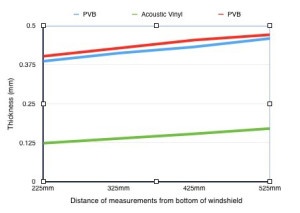 The problem then becomes how to measure the wedge or thickness of the laminate from top to bottom.
The generally accepted practice of using a micrometer to measure the laminate thickness at the top and bottom of the windshield is now obsolete, as manufacturers need to measure thickness across the whole windshield from top to bottom in a non-destructive manner.
How OptiGauge II Addresses the Problem
Lumetrics developed OptiGauge II to meet these exact needs. The system provides highly accurate, repeatable glass thickness measurements and can be customized to meet the many needs of windshield glass manufacturers.
OptiGauge II is trusted by the largest PVB manufacturers to measure the wedge angle in the PVB as it is being produced. In addition, auto glass manufacturers rely on it for product development, optical quality verification, and troubleshooting lamination issues during windshield fabrication.
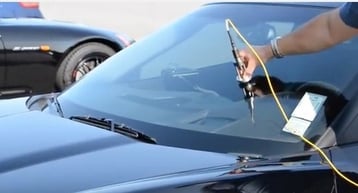
Lumetrics handheld probe holder with 50mm Probe.
The Lumetrics OptiGauge II is based on low-coherence interferometry, allowing it to deliver exceptionally precise measurements with accuracy down to ± 0.1µm. This non-contact, non-destructive technology ensures reliable results without compromising the integrity of the glass.
Discover how OptiGauge II fits into your workflow. Contact our team of experts today.